CUSTOM TENT BUYER GUIDE
What Should You Ask a Custom Tent Manufacturer Before Ordering? 15 B2B Due-Diligence Questions
Use this B2B supplier checklist to ask about tent design, materials, wind assumptions, testing, inspection, packing, shipment and after-sales support.
- Article
- CTA and inquiry-popup plan
# What Should You Ask a Custom Tent Manufacturer Before Ordering? 15 B2B Due-Diligence Questions
SEO information
- SEO title: 15 Questions to Ask a Custom Tent Manufacturer Before You Order
- Meta description: Use this B2B supplier checklist to ask about tent design, materials, wind assumptions, testing, inspection, packing, shipment and after-sales support.
- URL slug: `/blog/questions-to-ask-custom-tent-manufacturer`
- Primary keyword: questions to ask a custom tent manufacturer
- Recommended schema: `BlogPosting` plus visible FAQPage markup only when the on-page FAQ questions and answers are unchanged.
Article
Introduction
Choosing a custom tent manufacturer is not the same as selecting a finished retail product. The buyer is usually purchasing a project-specific configuration that must fit a site, an application, an installation process and an international delivery chain. A good conversation with the supplier therefore sounds less like “Which model is best?” and more like “Which assumptions are included, which documents are available, and who will verify each step?”
This checklist gives procurement teams, rental companies and project managers 15 questions to use before placing an order for commercial event tents, industrial storage tents, canopies or branded structures. The goal is not to make every purchase complicated. It is to expose the information that turns a quotation into a traceable, installable order.
Use the questions alongside a clear brief: purpose, target dimensions, installation location, expected duration, ground type, access, required doors and delivery destination. You can also start with our custom-tent specification guide if those inputs are not yet defined.
1. Can you restate our application and configuration in the quotation?
Before comparing price, ask the supplier to restate the job in a short scope paragraph. It should identify the intended product application, width, length, eave height, roof form, wall/door arrangement, site assumptions, location and delivery basis. If the supplier cannot describe the requirement accurately at this stage, later drawings and packaging are likely to drift from the brief.
Check that “custom” means a defined change rather than an unpriced wish. A special colour, printed skin, non-standard door, added height, linked layout or a particular accessory may change material, engineering, lead time, packing and installation. Ask what is confirmed, what is optional and what remains subject to technical review.
2. Which dimensions are usable inside the structure?
Request a drawing that distinguishes overall footprint, clear span, eave height, ridge height, leg positions, bays and door openings. For a warehouse, share vehicle and rack dimensions. For an event, share the seating, stage, service and exit plan. An external measurement is not necessarily a usable internal one.
Ask where the frame legs, tension straps, gutters, braces or door mechanisms sit. Ask whether any accessory reduces clear width or height. This level of detail prevents a frequent procurement problem: the structure arrives in the quoted size, but the operational layout does not fit.
3. What frame, roof and wall materials are proposed—and why?
Ask for the stated frame material and profile, roof/membrane type, wall options, connection details and hardware. The supplier should be able to explain why the combination suits the span, intended duration and application. Ask for product data, material samples where useful, colour/finish options and care guidance.
Avoid shortcuts such as comparing one aluminium tube dimension with another. A tent system depends on profile geometry, connections, bracing, roof form, anchors or ballast and the documented conditions of use. The question is whether the offered configuration addresses your project, not whether one isolated component sounds larger.
4. What site, wind, snow and anchoring assumptions are included?
This is one of the most important questions in commercial tent buying. Give the manufacturer the country/city, installation dates, exposure, surface type and any known authority or venue requirement. Ask the supplier to state the site and weather assumptions of the proposal, the anchoring or ballast concept, and the information still required before final design.
Do not accept an unspecified promise that the tent “handles all weather.” Conditions and regulations vary. The final configuration may require engineering review, site-owner permission, a weather-response plan or local authority approval. The supplier can provide product evidence, but it cannot replace the purchaser’s responsibility to establish the actual site conditions.
5. What local compliance documents can you provide for this project?
Ask for the documents available for the configuration and market—not a generic certificate folder. Depending on the product and jurisdiction, this may include drawings, material data, instructions, test reports, product declarations or engineering information. Then ask which requirements must be confirmed by a local engineer, authority, event organiser, insurer or site owner.
If a supplier claims an ISO management-system certificate, request a readable certificate copy, scope, site name, issue/expiry dates and issuing certification body. ISO itself does not certify companies; certification is carried out by external bodies. ISO’s official certification guidance explains how a certificate and certification body can be examined. A certificate is useful evidence, not proof that every individual tent configuration meets every local requirement.
6. Can we review a layout drawing before production begins?
The answer should be yes. A drawing review is the moment to check spans, bays, heights, wall panels, doors, gutters, branding, accessories and orientation. Mark the preferred entrance, truck route, drainage direction and links to existing buildings. Ensure the approved revision is identified in the contract and used for packing and inspection.
If anything changes after approval, ask for a revised drawing, scope impact and written confirmation. Uncontrolled changes create the most expensive kind of customisation: the change that is discovered only during installation.
7. What does factory testing mean for this order?
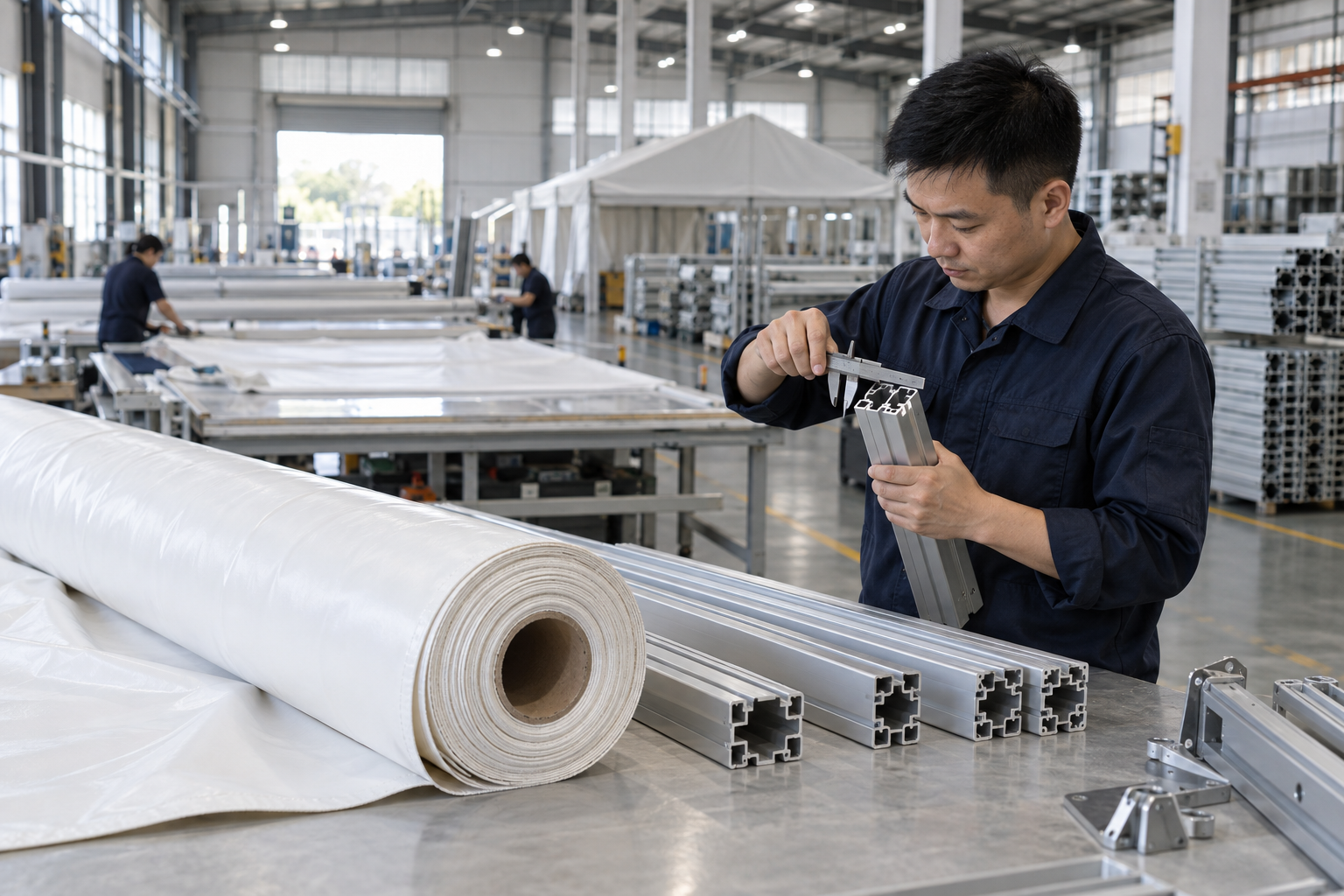
“Factory tested” is not a universal, self-explanatory label. Ask the manufacturer to define the test or inspection plan for your order. Depending on the configuration, practical controls may include measurement checks, visual inspection of frame and membranes, hardware/connection checks, trial fitting of representative components, label verification, packing-list reconciliation or a documented partial/full assembly.
Ask who performs the checks, when they occur, what record is issued, what acceptance criteria apply and what happens if an issue is found. If a test report is required, define its format and language before the order is released. This turns factory testing into evidence rather than marketing language.
8. May we arrange a third-party or pre-shipment inspection?
For a significant export order, a buyer may wish to appoint an inspection company or send a representative. Confirm this in the purchase order and agree the timing. A pre-shipment inspection normally works best when the finished goods, packaging and order documents can be checked before final container sealing.
Provide an inspection checklist: approved drawing/revision, component quantities, materials, visible condition, door/wall/accessory packages, labels, packing-list match, required documents and agreed photos. The inspector should report what was observed, not certify a condition outside the agreed scope. A clear inspection process protects both buyer and manufacturer.
9. How will components be labelled and packed for installation?
An elegant tent design is not helpful if the receiving crew cannot find the relevant parts. Ask how frame sections, roof panels, walls, doors, hardware and accessories are packaged and labelled. Will packages reference the drawing, bay number or packing list? Are fabric goods protected from moisture, abrasion and sharp edges? Which pieces are heavy or long enough to need special unloading equipment?
Request sample packing photos for comparable orders if available. For a first installation, a package map and labelled hardware kits can save hours of sorting. Agree who supplies tools, lifting equipment, manuals and spare fasteners.
10. Which shipping terms and documents are included?
Clarify the agreed Incoterm, origin/destination point, export packaging, freight responsibility, insurance responsibility, customs roles and expected documents. Do not assume “shipping included” means all destination handling or import charges are included. The commercial team should align the shipping term with the buyer’s freight-forwarding and customs process.
For the shipment inspection, reconcile the packing list against the purchase order and approved drawing. Check package count, marks, gross weight/measurements where relevant, frame bundles, membrane packages, doors, hardware, manuals and accessory boxes. Photograph container loading or sealed packages if that is part of the agreed evidence set.
Mid-article CTA — ask for a supplier-review pack
Want a quotation you can compare line by line? Send your project brief. We can provide a configuration checklist covering drawing revision, materials, site assumptions, packing and shipment inspection points.
11. Who is responsible for installation preparation and site readiness?
Ask the supplier to list the conditions assumed for installation: level surface, access road, unloading zone, erection area, lifting equipment, anchoring/ballast method, local labour, exclusion zone and weather. The buyer should confirm who checks underground services and gains approval for any ground fixing.
If the factory will provide remote guidance, supervision or an installation crew, define the scope, travel, language, local safety induction, equipment and buyer responsibilities. Do not confuse a product manual with site management. A successful installation needs both.
12. What training, manual and handover support will be provided?
For repeat deployments, rental operations and large structures, ask for installation instructions, component identification, maintenance guidance and a handover checklist. Confirm the language and format. If a crew has not installed the system before, schedule an orientation or supervised first build where appropriate.
During handover, record the approved configuration, site deviations, installed accessories, visible condition and any open items. Store the manual, drawing, inspection records and packing list in one project folder. This makes later maintenance, insurance enquiries or relocation more manageable.
13. What warranty and after-sales process applies?
Ask for written warranty terms, exclusions, claim procedure, response channel and spare-part process. Clarify whether the warranty is affected by self-installation, unauthorised modifications, abnormal site conditions, poor storage or missed maintenance. Warranty language should identify the product scope and time period; it should not be a vague statement on a quotation.
Ask how replacement membranes, frame members, connectors or hardware are identified and shipped. A manufacturer who retains drawings, part names and order records is easier to work with after delivery.
14. Can you show relevant experience without overstating it?
Ask for comparable applications, photographs, product ranges or anonymised case information that the supplier is permitted to share. Look for relevance: similar span, use, climate, access, duration and accessory mix. A beautiful small event image is not proof of capability for a large warehouse requirement.
The buyer should also check communication quality. Are questions answered specifically? Are assumptions written down? Does the supplier flag unresolved conditions? A responsible manufacturer is comfortable saying what must be verified rather than inventing certainty.
15. What is the full sequence from deposit to handover?
Request a project flow that includes scope confirmation, drawing approval, material preparation, production, factory testing, pre-shipment inspection, balance payment, shipment, customs/receiving, site preparation, installation and handover. Assign an owner for each step. Share the target opening date, but leave time for dependencies outside the factory’s control.
This sequence creates a useful procurement record. It also gives both parties an early warning if a required approval, delivery document or site task is slipping.
A practical supplier scorecard
Score each supplier against the same criteria: technical fit, evidence quality, response precision, drawing control, material transparency, site-assumption clarity, inspection openness, packaging plan, shipping terms, installation support and after-sales process. Price matters, but it should be read next to scope and evidence.
For a custom tent project, the strongest supplier is often not the one that answers “yes” to everything. It is the one that asks the right questions before production, documents decisions, and gives the buyer an auditable route from RFQ to installed structure. Explore the factory process on our Factory page and compare project applications in Custom Solutions.
FAQ
#### What is the first question to ask a custom tent supplier?
Ask the supplier to restate the use case, dimensions, site, duration, accessories and delivery basis in writing. This confirms that both sides are quoting the same project.
#### Should I ask for a tent sample before ordering?
For fabric colour, translucency, print, wall material or a special finish, a sample can be valuable. For the overall structure, a technical drawing, material data and agreed inspection plan are usually more relevant than a small sample alone.
#### What should a pre-shipment inspection cover?
At a minimum, agree the configuration revision, countable components, visible condition, labels, packing-list match, accessory packages, documents and photo record. Define the scope and acceptance criteria in advance.
#### How do I verify an ISO certificate shown by a supplier?
Request the certificate copy, certification-body name, scope, site and validity dates. ISO explains that it does not issue certificates itself and recommends examining the certification statement/body. Treat it as one item of supplier evidence, not a blanket product approval.
#### Why do tent manufacturers ask about ground type and location?
Ground, access and local conditions affect installation preparation, anchoring or ballast options, logistics, weather assumptions and local approvals. They are fundamental inputs, not administrative details.
Conclusion
Supplier due diligence is not a bureaucratic hurdle. It is the process that connects your operational need to a verifiable configuration, a practical installation and a complete shipment. Ask about scope, usable dimensions, materials, site conditions, documents, drawing control, factory testing, inspection, packing, delivery and after-sales support before the purchase order is final.
The result is a better comparison between suppliers and fewer surprises when goods reach the site.
Final CTA
Send us your supplier-evaluation questions or project brief. Contact us for a structured custom-tent quotation with a drawing-review, factory-inspection and shipment-preparation checklist.
START A PROJECT
Send us the basics.
We will reply with the right next questions for your custom tent requirement.