Handling and transport
Component size, weight, lifting plan and deployment frequency affect operating cost.
FRAME MATERIAL COMPARISON
Material name alone does not determine strength, durability or suitability. Review profile, geometry, connections, finish and project duty.
APPLICATION-LED SOURCING
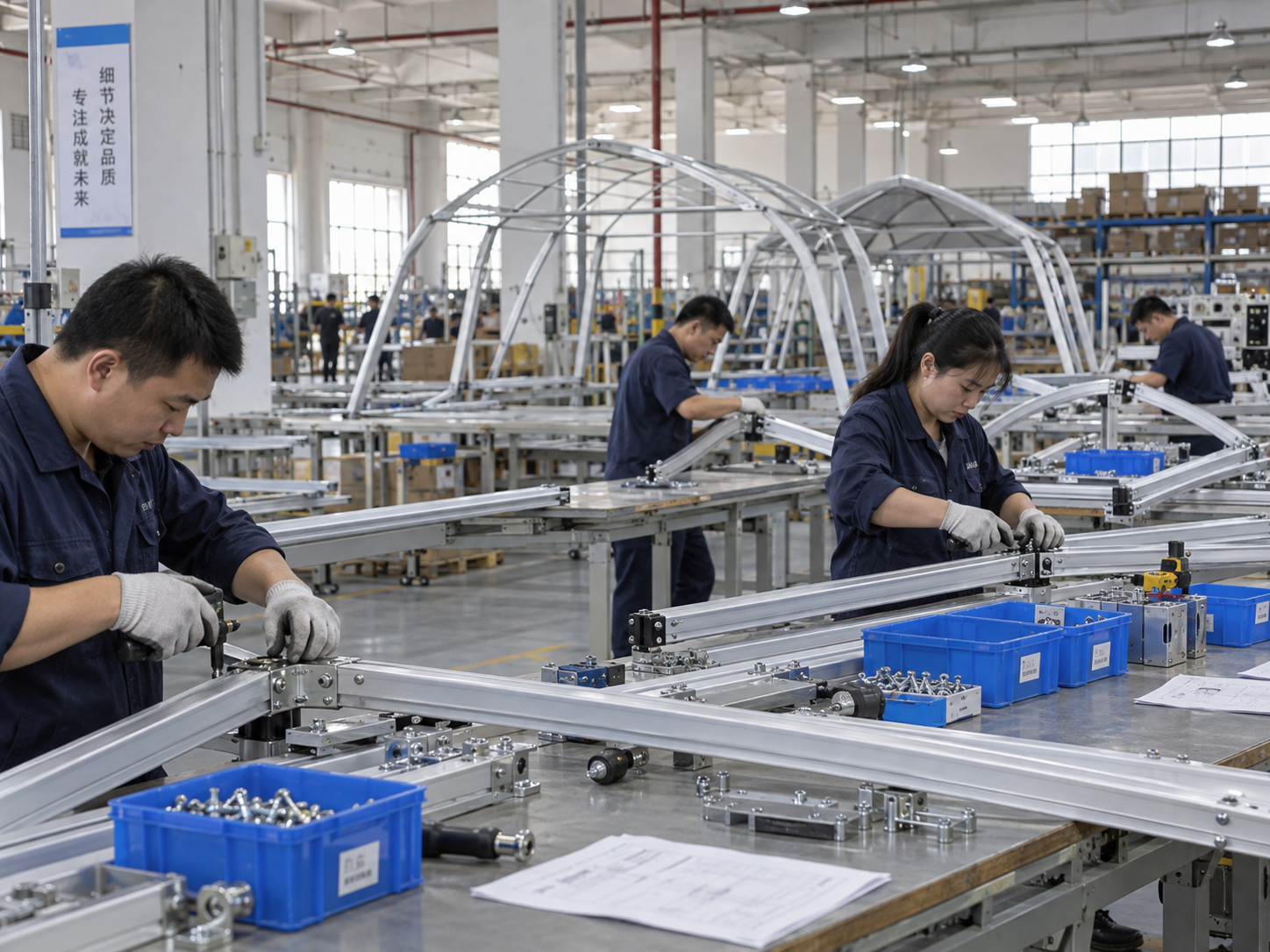
Aluminium is common in modular clear-span event systems because of its weight, corrosion behavior and extruded profile possibilities. Steel is used in many shelters and supporting components where geometry, fabrication and cost lead to a different solution. Buyers should compare the offered system, not assume that one material label proves performance.
WHERE IT FITS
Component size, weight, lifting plan and deployment frequency affect operating cost.
Profile shape, grade, wall thickness, bracing, connections and bay geometry work together.
Moisture, salt, chemicals, abrasion and storage conditions affect finish and maintenance.
Repair, replacement parts, inspection and fleet compatibility influence lifecycle value.
SIDE-BY-SIDE COMPARISON
| Decision area | Aluminium frame | Steel frame |
|---|---|---|
| Weight | Generally lower density, useful for modular handling | Generally heavier for comparable component volume |
| Profile options | Extruded profiles can integrate tracks and system features | Rolled or fabricated sections support varied shelter geometries |
| Corrosion approach | Natural oxide layer plus selected finish; environment still matters | Requires an appropriate coating or galvanizing system and maintenance |
| Fabrication | Extrusion, machining and system connectors are common | Welding, forming, bolting and coating are common |
| Repair and parts | Often relies on manufacturer-specific profiles and connectors | Fabrication may be locally accessible, but geometry and grade must match design |
| Typical use | Modular event and clear-span systems | Selected industrial shelters, subframes and application-specific systems |
PURCHASING FRAMEWORK
Ask each supplier to identify the actual material and system being offered.
PREPARE A STRONGER RFQ
Send the use, dimensions, quantity, destination and required date. We will identify the next technical and commercial questions.
Send Your RequirementsA CONTROLLED PROJECT PATH
Record use, span, height, deployment frequency, environment and service duration.
Compare profile, bracing, connectors, finish, component weights and maintenance.
Align drawings, calculations, material records and inspection points with the final configuration.
Identify cleaning, inspection, storage, repair, spare parts and end-of-life replacement.
FACTORY & PROCUREMENT EVIDENCE
Salt, chemicals, trapped moisture, abrasion, damaged coatings and incompatible metals can create corrosion risk. The operating team should follow the manufacturer’s inspection and maintenance guidance.
BUYER QUESTIONS
No. Suitability depends on the complete system, span, geometry, environment, handling, maintenance, cost and project design. Both materials can be appropriate in correctly designed applications.
No material should be described as universally corrosion-proof. Alloy, finish, environment, contact with other materials, cleaning and maintenance all affect performance.
Aluminium components are often lighter, but actual package weight depends on profile size, geometry, quantity and packing. Compare the supplier’s package and component data.
Request drawings, material references, finish description, component schedule, design or test evidence relevant to the order and the agreed inspection records.
START A PROJECT
Send the span, height, application, environment, deployment pattern and required evidence for the proposed structure.