Duration and certainty
Stable long-term demand may support permanent investment; temporary or uncertain demand may value flexibility.
CAPACITY OPTION COMPARISON
Compare time, site commitment, environmental control, flexibility and total project scope before adding covered capacity.
APPLICATION-LED SOURCING
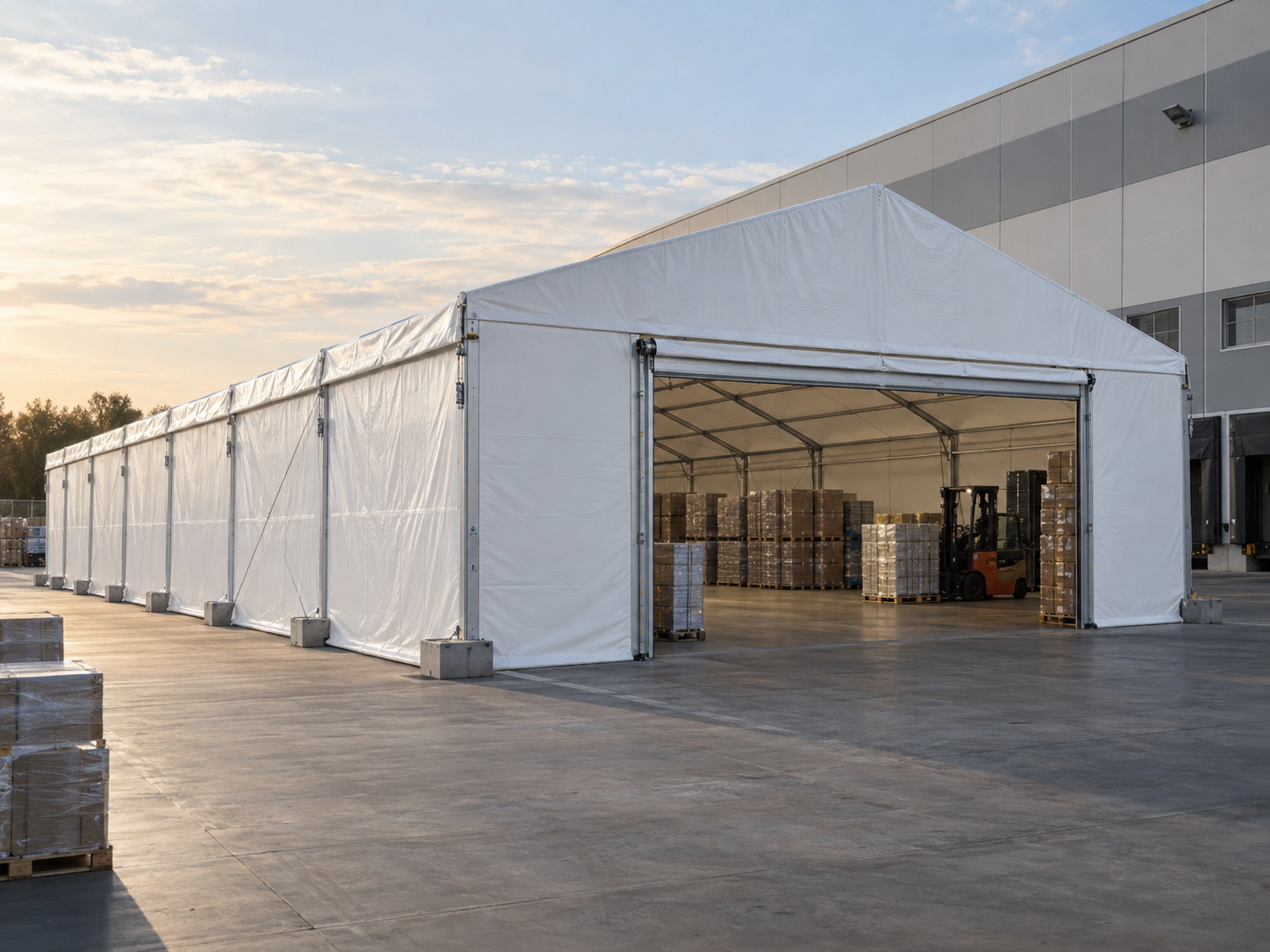
A temporary warehouse tent can support seasonal inventory, disruption recovery or staged expansion near an existing operation. A permanent building may be stronger for long-horizon use, intensive services, controlled environments or asset investment. Buyers should compare operating needs and total responsibility rather than assume either option is universally faster or cheaper.
WHERE IT FITS
Stable long-term demand may support permanent investment; temporary or uncertain demand may value flexibility.
Tight temperature, humidity, hygiene or fire requirements may favor a conventional building solution.
A tent can preserve proximity to current operations when remote leased space would add handling.
Relocation, expansion or removal may be easier with a modular structure, subject to design and condition.
SIDE-BY-SIDE COMPARISON
| Decision area | Warehouse tent | Permanent building |
|---|---|---|
| Best horizon | Temporary, seasonal, phased or uncertain demand | Stable long-term demand and permanent site strategy |
| Site commitment | Potentially reversible but still needs approved ground interface and permits | High commitment through foundations, utilities and permanent works |
| Environmental control | Basic enclosure or selected systems; limitations must be defined | Can integrate permanent insulation and building services more comprehensively |
| Flexibility | Modular extension, relocation or removal may be possible | Alteration is usually a conventional construction project |
| Project speed | May reduce structure lead time, but approvals and site work still apply | Longer design and construction path in many cases |
| Asset model | Equipment or temporary-structure treatment depends on local accounting and contract | Permanent real-estate asset subject to local treatment |
PURCHASING FRAMEWORK
Compare the same operating period, capacity and performance requirements across every option.
PREPARE A STRONGER RFQ
Send the use, dimensions, quantity, destination and required date. We will identify the next technical and commercial questions.
Send Your RequirementsA CONTROLLED PROJECT PATH
State capacity, environment, access, uptime and duration in measurable terms.
Price the tent, permanent build, leased space and process alternatives against the same need.
Include site, approvals, utilities, freight, installation, operations and exit costs.
Test schedule, demand, compliance, weather, maintenance and residual-value assumptions.
FACTORY & PROCUREMENT EVIDENCE
Temporary structures can still require engineering, permits, fire planning, inspections, ground works and operational controls. Confirm requirements with qualified local authorities and professionals.
BUYER QUESTIONS
No. Compare the same performance and period, including ground work, approvals, services, freight, installation, maintenance, energy and eventual removal or residual value.
Potential duration depends on the system, site, local rules, maintenance and operating conditions. A longer planned use requires explicit review rather than assuming that temporary means unrestricted.
It may be better when demand is durable, the site is strategic, substantial utilities or environmental control are needed, and permanent capital investment is justified.
Include capacity, duration, site preparation, structure, doors, environmental systems, approvals, freight, installation, operation, maintenance and exit or relocation.
START A PROJECT
Send the footprint, height, goods, site, duration, environmental needs and required operating date.